Solar proposal software that runs the whole sale
Design and string the roof in 3D, hand over the single line diagram, size the battery and heat pump, then send a branded solar sales proposal and follow it in your CRM. No CAD plugins, spreadsheets or email threads.

What's New
Latest from the product changelog
Stop duct-taping five tools together
Most solar sales teams still design in one tool, redraw the electrics in CAD, run the numbers in Excel and chase deals by email. Data is rekeyed at every step, proposals take hours and pricing drifts between reps. SolarVis keeps every step on one project record, from the roof outline to the accepted proposal.
Solar proposal software for every step of the sale
Seven modules on one project record. Design the system, document it, size storage and heat, price it and sell it without switching tools.


3D Design & Simulation
AI detects the roof, you refine it in 3D and fill it with panels in seconds.
- AI roof detection and Fit to LiDAR
- AI panel placement and automatic stringing
- Projects up to 50 MW in one design
Single Line Diagram
Generated from your 3D design, with electrical checks while you edit.
- Updates when the design changes
- Around 40 electrical symbols
- PDF and DXF with your title block
Battery Modeling
Size storage on an hourly simulation, with the tariff it will run on.
- Self-consumption, autonomy and arbitrage
- Backup reserve in every mode
- Its own proposal page
Heat Pump Modeling
Size the heat pump from the building and run it on the same PV and battery.
- Heating, cooling and hot water loads
- COP-based sizing
- Its own proposal page
Tariff & Regulations
Utility tariffs and country rules applied to every simulation.
- Net metering and net billing
- Time-of-use, tiered and demand charges
- 45+ countries supported
Proposal Generation
Branded proposals built from the design, the bill of materials and the savings.
- White-label templates
- Send by email, SMS or link
- Views and reading time tracked
Solar CRM
Contacts, leads and projects on one shared timeline.
- Pipeline stages with required tasks
- Activity feed with proposal views and replies
- Team assignment
Everything your solar sales team needs, in one browser tab
Seven capabilities that replace entire product categories. Each one feeds the next, so the roof you draw is the system you document, price and sell.
AI detects the roof, AI places the panels, you ship the design
AI roof detection turns satellite imagery into a roof wireframe, and Fit to LiDAR lifts it into 3D wherever high-resolution roof data covers the address. Model adjoining sections at their own height, then let AI panel placement fill the layout to your target while respecting setbacks, obstacles and shading. Automatic stringing then wires the layout into strings within the inverter limits. Several buildings per project, and up to 50 MW in a single design.
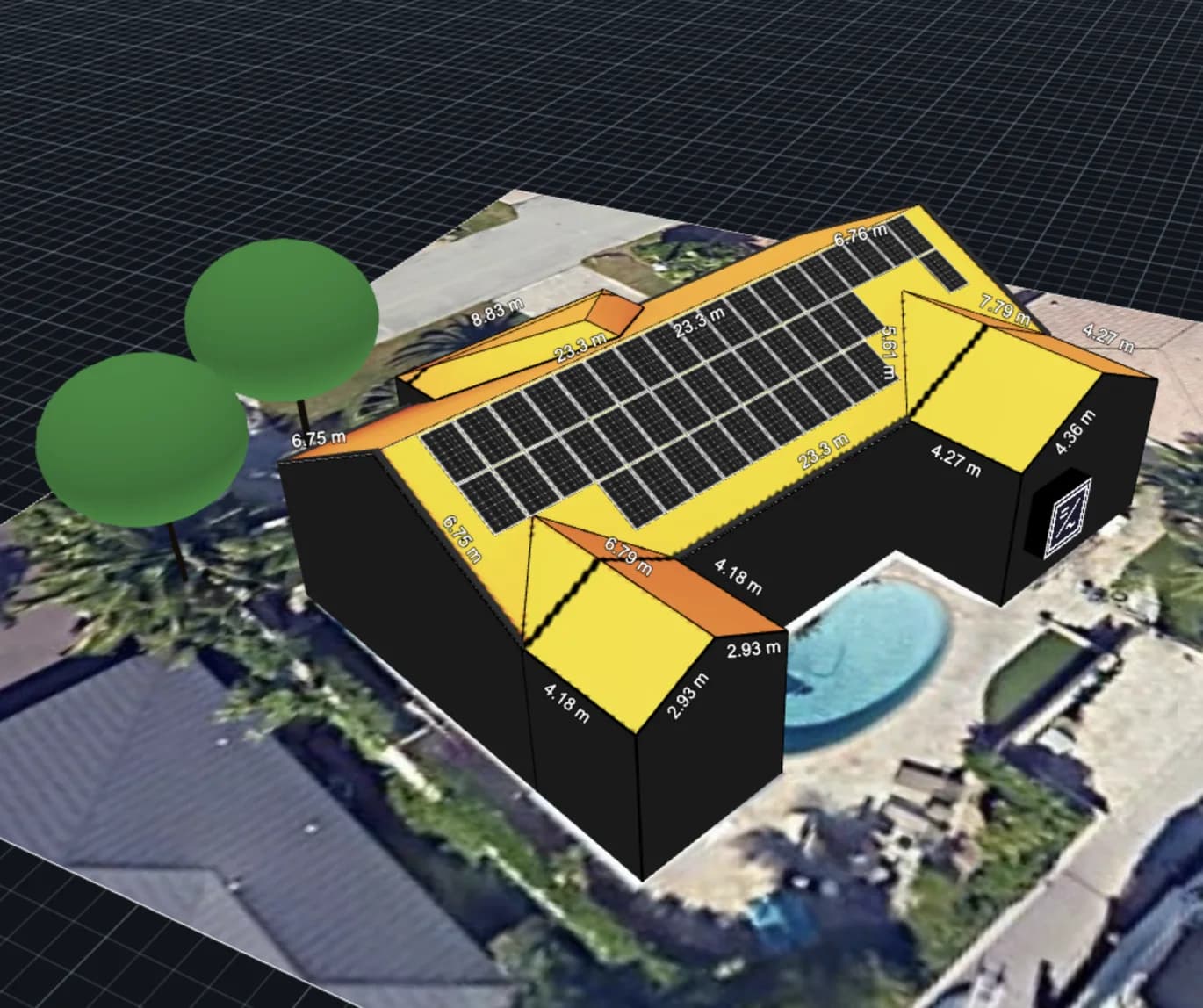
The single line diagram comes from the design you already made
One click opens the single line diagram, already drawn from your 3D design. Voltages and currents are checked against the inverter limits as you edit, around 40 electrical symbols cover the rest of the system, and the sheet goes out with your company title block as PDF or DXF. Change the design and the diagram follows.
Drag onto the diagram, or click to add
One design, four revenue streams
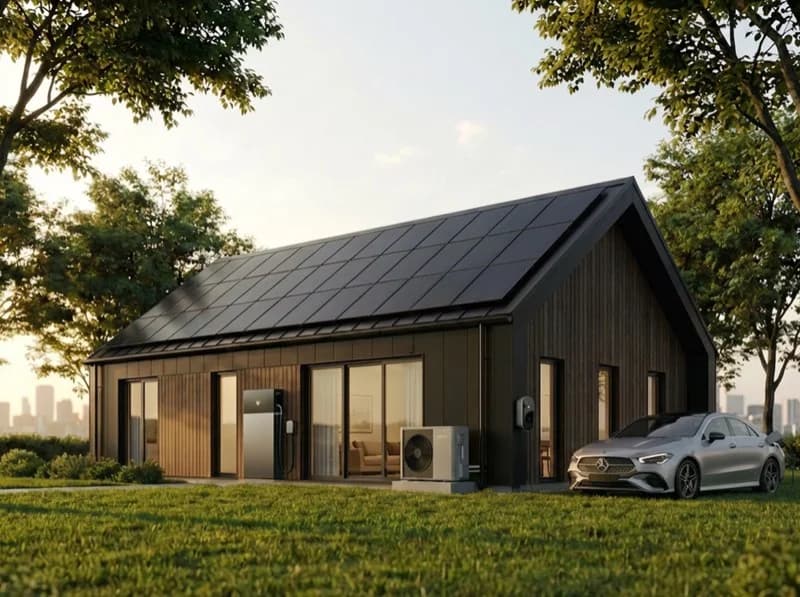
Add a battery, a heat pump and an EV charger to the same project. The battery is sized on an hourly simulation in self-consumption, autonomy or arbitrage mode, with arbitrage on on-grid designs. The heat pump is sized from the building and its heating, cooling and hot water loads. Each gets its own proposal page, so a PV quote becomes a bigger deal.
Numbers your customer and their bank can trust
Every design runs through an in-house hourly simulation over the full year, with cell-level shading, on the utility tariff and regulations of the site's country. Payback, annual savings and the 20-year cumulative cash flow come straight from that simulation, probabilistic P50, P90 and P99 yield is available with typical meteorological year weather data, and the hourly results export to Excel.
Send a branded proposal and know when it is read
One click turns the design, the bill of materials and the savings into a white-label proposal, assembled from the pages you choose. Send it by email, SMS or link, see how often and how long it was viewed, and get the customer's acceptance or rejection, with the reason, straight into the project.
Every lead, proposal, and project on one shared timeline
A solar-native CRM whose pipeline follows the real journey, from waiting for a proposal to installation. Stages can require tasks before a project moves on, and the activity feed records every assignment, proposal view and reply, so nothing loses context on its way through the funnel.
Fill the top of the funnel on the same platform
Put the Solar Lead Generator on your website to capture qualified leads with an instant solar estimate, and let the AI Sales Agent answer visitors around the clock. Their leads land in the same CRM, ready for a design and a proposal.
From project kickoff to a sent proposal in 8 steps
A typical solarVis project moves through 8 steps, and data only flows forward. Enter consumption once, and it drives the design, the stringing, battery and heat pump sizing, the bill of materials and the proposal.
- Excel
- PVsyst
- PV*SOL
- AutoCAD


How solarVis compares with other solar proposal software
Buyer's guide: solar design software
Compare solar design software the way installers buy it: roof capture, layout, yield, proposals and pipeline. Seven tools, honest picks by business type.
Aurora Solar vs solarVis
Aurora Solar vs solarVis in 2026: US-first design automation, or tariffs for 45+ countries, heat pumps and CRM in one flow. An honest verdict.
OpenSolar vs solarVis
OpenSolar is free, and this comparison says so. See what solarVis adds: heat pump sizing, tariffs for 45+ countries and a stage-gated CRM.
Reonic vs solarVis
Reonic vs solarVis in 2026: a demo alone, or a demo and a 7-day free trial, with tariffs for 45+ countries and 24 languages. Where each one wins, honestly.
Go deeper into the platform
Single Line Diagram
Generate the single line diagram from your 3D design, with electrical checks built in.
Battery Modeling
Size storage for self-consumption, autonomy or arbitrage on an hourly simulation.
Heat Pump Modeling
Size heat pumps from the building's heating, cooling and hot water loads.
Solar Lead Generator
Turn your website traffic into qualified solar leads with an instant estimate.
Common questions about solarVis
Solar proposal software combines roof design, yield and savings simulation, pricing and proposal generation in one tool. SolarVis also carries the stringing, the single line diagram, battery and heat pump sizing and the CRM record on the same project, for residential, commercial, industrial and agricultural work, with tariffs and regulations supported across 45+ countries.
SolarVis includes 3D roof design and simulation with automatic stringing, the single line diagram, battery and heat pump sizing, tariff-accurate savings, branded proposals and a solar CRM. Not just templates: a full workflow from the first lead to the accepted proposal and on to installation.
Yes. SolarVis is built for rooftop-focused residential, commercial, industrial, and agricultural solar projects. Teams can generate designs, feasibility checks, and proposals for each project type in one workflow.
SolarVis supports on-grid, off-grid and zero-injection systems. You can model each project around its connection type, tariff logic, export rules and proposal requirements.
Minutes, not hours. A typical residential proposal takes under 10 minutes from new project to shareable PDF. The 8-step workflow keeps data flowing forward, so nothing is rekeyed.
Yes. Once the 3D design is complete, the single line diagram opens already generated from it. SolarVis checks voltages and MPPT currents against the inverter limits as you edit, and exports the sheet with your company title block as PDF or DXF. Cable sizing and protection devices stay with the engineer, and the diagram is a standalone sheet, not a page of the customer proposal.
Yes. Battery, heat pump and EV charger are part of the same design. The battery is sized on an hourly simulation in self-consumption, autonomy or arbitrage mode, with arbitrage on on-grid designs. The heat pump is sized from the building's loads, and each technology gets its own page in the proposal.
It works wherever high-resolution roof data covers the address, which is broadest in North America and Europe. There, AI roof detection draws the roof outline and Fit to LiDAR sets heights and slopes. Everywhere else you draw and slope the roof by hand with the same tools, and the rest of the workflow is identical.
Yes. Many markets already include pre-built regulation and tariff sets. If your country is not pre-built, you can add the rules yourself in the tariff configurator or contact solarVis to request support for that market.
Yes. The entire platform is available in 24 languages, including English, German, Turkish, French, Spanish, Italian, Dutch, Portuguese, Polish, Czech, Russian, Arabic, and Thai. Each user chooses their own interface language, so mixed-language teams and international dealer networks can all work in one account.
Yes. Full template customization, including logo, colors, fonts, layout, and commercial terms. Entity-based branding is available for dealer networks, so each partner can ship proposals in their own brand.
Faster, more accurate, financing-ready output, no version drift, centralized pricing, and audit trails. Excel-based feasibility is rarely sufficient for solar lending workflows. SolarVis outputs are used in bank credit evaluation processes.
Yes. SolarVis covers residential, commercial, industrial and agricultural projects. Commercial designs support several roofs and buildings per project, AI panel placement with flat-roof racking, automatic stringing with MPPT checks, and up to 50 MW in a single design. Pricing, tariffs and proposal templates adapt to project size, so the same workflow covers a 10 kW rooftop and a multi-megawatt commercial installation.
Compare four things: design accuracy (3D modeling with shading analysis and electrical design), feasibility depth (tariffs, regulations and financing-ready reports), proposal quality (branded, white-label output with tracking) and workflow integration (CRM and lead tools in the same platform). SolarVis combines all four in one platform, used by 1,800+ solar installers, with tariffs and regulations supported across 45+ countries. Our buyer's guide to solar design software compares the main platforms side by side.
Yes. Proposals can include a Production Analysis page with a monthly and annual Performance Ratio and, for PVGIS projects using a typical meteorological year, probabilistic P50, P90, and P99 production estimates. You choose whether the Performance Ratio, the probabilistic analysis, or both appear, and an optional shade report can be added as its own section.
SolarVis is sold as one platform on annual plans, and design, proposals and the CRM are part of every plan. See the pricing page for the current plans and what each one includes.
