Energy security starts at the building: why solar, storage, and heat pumps are the structural fix
Energy security is not only about supply, it is about affordability. From the Russia-Ukraine gas crisis to the Strait of Hormuz, geopolitical shocks keep landing on energy bills. The structural fix is electrification: local solar, battery storage, and heat pumps.
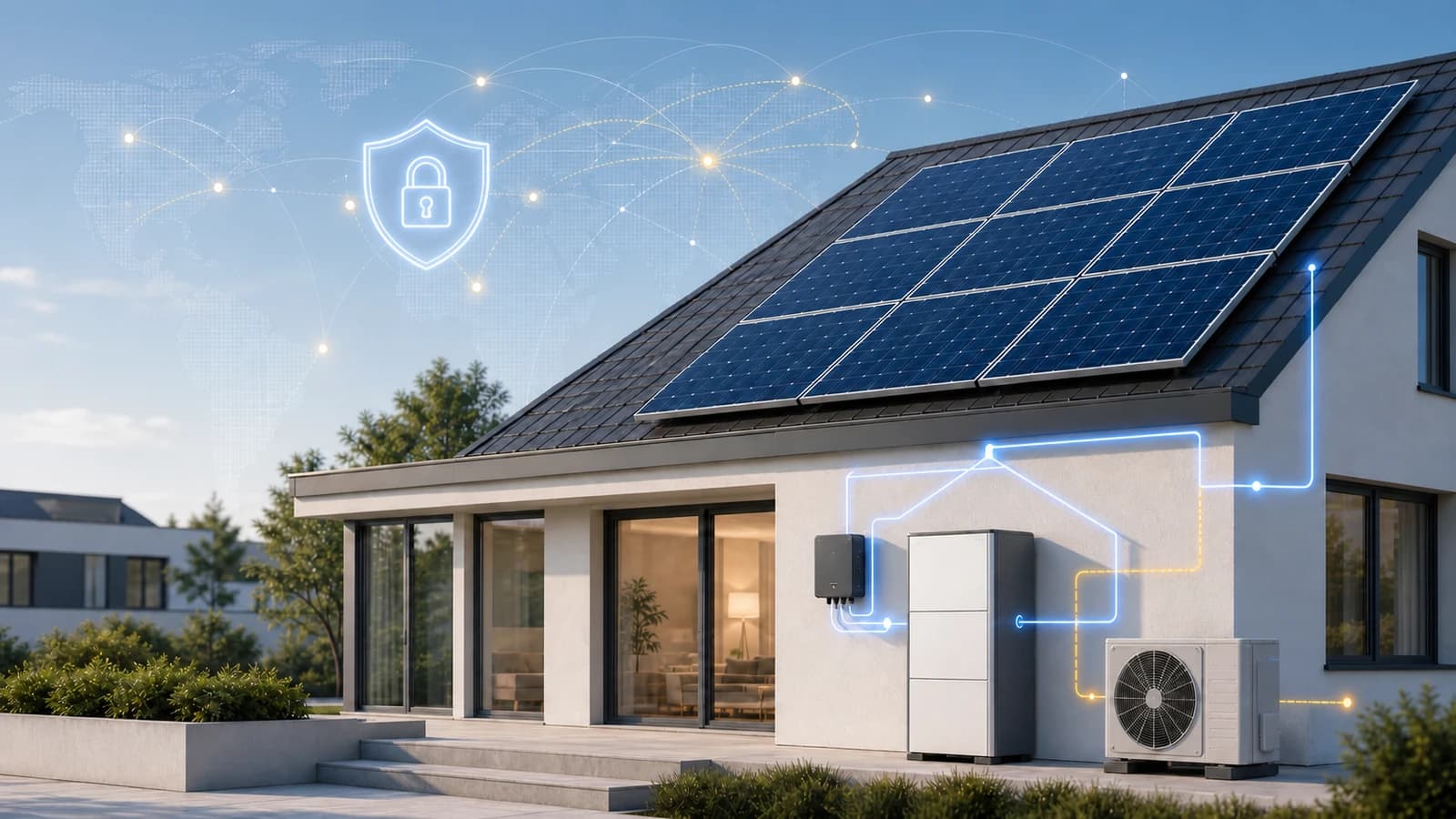
Energy security is usually framed as a question of physical supply: do the tankers reach port, does gas keep flowing, do power plants and heating systems stay fed. That framing captures only half of the problem. Energy that is technically available but unaffordable inflicts the same economic damage as energy that is physically absent. The recurring pattern of the last decade is not a shortage of energy but a surge in its cost, triggered by conflict thousands of kilometers away. This piece traces how a geopolitical shock becomes a household bill, why the pattern keeps repeating, and why the durable answer is not another emergency subsidy but electrification: local solar, battery storage, and heat pumps.
What is energy security?
Energy security is the ability of households, businesses, and economies to access energy that is both physically available and affordable. The first dimension, availability, is the one most people picture. The second, affordability, is the one that actually reaches the bill. Energy that flows but costs three times what it did last year is not secure in any sense that matters to a household or a factory.
The link between a geopolitical event and a consumer cost runs through a remarkably short chain. Disruptions at the point of extraction or transit cause commodity prices to spike. In gas-linked power systems, those increases flow directly into wholesale electricity markets. Households and businesses are then hit from several directions at once: rising electricity bills, rising heating costs, and broader inflation in goods and services.
Energy supply security is not just about whether energy is available. It is about whether people and businesses can afford it. A price crisis is a supply crisis in disguise.
A stress test that already happened: the Russia-Ukraine gas crisis
Before February 2022, Europe imported roughly 40 percent of its natural gas from Russia. The prevailing assumption was that mutual economic dependency would prevent any disruption. That assumption collapsed within months. The TTF gas benchmark surged from roughly 20 euro per MWh to over 300 euro per MWh, and wholesale electricity followed, with German day-ahead contracts exceeding 700 euro per MWh on peak days.
Sources: ICE, ENTSO-E, Ember
The consequences ran far beyond energy markets. Energy-intensive industries cut production, millions of households fell into energy poverty, and governments mobilized extraordinary fiscal support to shield consumers[1]. Europe's policy response, in turn, moved to accelerate renewables and heat pump deployment as a security measure, not only a climate one[2].
Gas-dependent households had no rapid fuel-switching option when prices surged. The heating bill shock was as severe as the electricity shock, yet it received far less public attention. A home tied to a single imported fuel has no fallback when that fuel triples in price.
The next shock: the Strait of Hormuz
The Strait of Hormuz is the single most critical energy chokepoint on earth, carrying roughly 21 million barrels of oil per day along with major volumes of LNG[3]. Any disruption to that corridor, whether through direct military action, proxy conflict, or shipping restrictions, would send immediate shockwaves through global energy markets. This matters well beyond Europe: oil and LNG price shocks ripple across every import-dependent economy, affecting electricity generation costs, industrial competitiveness, freight, and household budgets.
The chokepoint concentration is the structural weakness. A handful of narrow corridors carry a large share of the world's traded oil, and Hormuz carries more than any other.
Sources: U.S. EIA, IEA, Reuters
The risk is not binary. Even a threat premium with no actual disruption can raise fuel costs materially. A partial disruption tightens LNG and oil balances across regions. A full closure or severe shipping restrictions would create global price spikes on the scale of 2022, or worse.
From geopolitics to your energy bill: the merit-order effect
The transmission chain from a geopolitical event to a household bill is shorter than most people realize. In gas-linked electricity markets, the wholesale price is often set by the most expensive generator dispatched, typically a gas-fired plant. This is the merit-order mechanism: even when much of the electricity mix comes from cheaper renewables or nuclear, the marginal gas plant can still set the market price for all of it.
The most expensive generator dispatched, usually a gas plant, sets the wholesale price for the entire market, even when cheaper renewables and nuclear supply most of the electricity.
The consumer impact is concrete. A 50 percent increase in wholesale gas prices would add roughly 400 to 600 euro per year to a typical European household's energy bill, combining electricity and heating. A doubling of gas prices, as occurred in 2022, would push that figure well above 1,000 euro. Similar pressures appear globally wherever households rely on imported fuels or gas-linked electricity tariffs[4]. On the commercial side, energy-intensive SMEs face margin compression within weeks, and during the 2022 crisis European ammonia and aluminium producers saw output reductions exceeding 25 percent.
| Disruption scenario | Oil price | Gas price | Household cost per year |
|---|---|---|---|
| Low: tensions, no disruption | +10 to 15% | +15 to 25% | +200 to 400 euro |
| Medium: partial Hormuz disruption | +25 to 40% | +40 to 70% | +500 to 800 euro |
| High: full strait closure | +60 to 100% | +100 to 200% | +1,000 to 2,000 euro and up |
Why this keeps happening: the architecture, not the war
Every few years, a new geopolitical crisis demonstrates the same vulnerability. The location changes, the players change, but the outcome is always the same: energy prices surge, economies suffer, and governments scramble for fiscal responses. This is not a coincidence. It is the predictable consequence of an energy architecture built on centralized, globally traded fossil fuels.
The Strait of Hormuz, like the Russian pipeline network before it, is the latest expression of a structural problem, not its root cause. Systems built on long, centralized supply chains will always be vulnerable to disruption, speculation, and price volatility. Treating each crisis as an isolated emergency, rather than as a symptom of the architecture, guarantees the next one.
The structural fix: electrification
The durable solution is to replace imported fossil fuels with locally generated electricity, store it, and use it efficiently. Three technologies do the work.
Solar: near-zero marginal cost
Renewable energy, and solar in particular, operates at near-zero marginal fuel cost. Once installed, the cost of generating each kilowatt-hour is fixed and largely immune to commodity price fluctuations. During the 2022 crisis, countries with higher renewable shares experienced measurably smaller price spikes. Globally, renewable additions have continued to accelerate, reinforcing the case for local electricity production as a resilience strategy, not only a climate strategy[5][6].
Battery storage
Battery storage costs have declined by more than 80 percent since 2010, making solar-plus-storage systems increasingly competitive. Behind-the-meter battery energy storage systems let households and businesses store excess solar generation during the day and use it during expensive evening hours or outages. That combination transforms energy from a commodity purchased at volatile market prices into a locally produced, locally stored resource, and at scale it can feed virtual power plants that add flexibility to the whole grid[7].
Heat pumps
Heating is one of the largest remaining fossil fuel dependencies in buildings worldwide. Gas boilers typically operate at a coefficient of performance (COP) of roughly 0.9, converting less than one unit of useful heat for each unit of gas burned. Heat pumps, by contrast, commonly achieve a COP of 3 to 5, delivering multiple units of heat for every unit of electricity consumed. That efficiency makes them central not only to decarbonization but to energy security, because it removes the last major reason a building needs a delivered fossil fuel at all[8][9].
Sources: EHPA, IEA
The integrated self-sufficient building
A building equipped with rooftop solar, a battery, and a heat pump becomes a substantially self-sufficient energy node. Solar panels generate electricity from a local, free source. Batteries shift surplus energy to evening and night hours. Heat pumps convert electricity into heating at three to five times the efficiency of gas. Each kilowatt-hour produced and consumed on-site is one that cannot be disrupted by conflict in the Strait of Hormuz, pipeline sabotage, or LNG shipping delays.
What should be done
The structural direction is clear: electrification, decentralization, and local generation. Translating it into reality requires coordinated action at every level.
- Governments should accelerate renewable deployment, phase out new gas boiler installations, reform electricity market design so consumer prices are less tightly linked to marginal gas costs, and invest in storage and critical infrastructure protection.
- Businesses should invest in on-site generation to reduce exposure to wholesale price volatility, deploy storage for peak management and backup, and electrify process heat where feasible.
- Households should install integrated systems combining solar, storage, and a heat pump, replace gas boilers, and use available subsidies, tax benefits, and financing programs. Understanding the local net metering and export rules is part of getting the economics right.
The common thread is simple. Every one of these moves energy production closer to the point of consumption, reduces dependence on globally traded fossil fuels, and builds resilience against the next geopolitical shock.
The solarVis perspective
SolarVis exists to accelerate the shift from centralized energy risk to decentralized energy resilience. We do this not by building panels or manufacturing batteries, but by enabling the ecosystem that designs and deploys them. Our platform evaluates integrated energy systems holistically, combining solar, battery storage, and heat pumps into configurations tailored to each building, location, and consumption profile.
Accurate system design is not a minor detail. It is the difference between an installation that maximizes energy production and one that underperforms, which is why the modeling behind a quote matters as much as the quote itself (the same reason we obsess over irradiance, shading, and string design). This is also why solarVis lets even small installation companies gain the capabilities they need to scale: the energy transition cannot be driven by a handful of large corporations alone. It requires thousands of local installers equipped with professional tools, accurate solar 3D design and simulation, and the confidence to design systems that perform.
That work spans the full integrated system, from battery modeling to heat pump modeling, and it is grounded in the local tariffs and regulations that decide project economics in each market. Today solarVis is used by 1,800+ solar installers, with tariffs and regulations supported across 45+ countries.
The transition to clean energy is happening worldwide and it is unstoppable. It is not a question of if, it is just a matter of how soon.
That was the assessment of Fatih Birol, Executive Director of the International Energy Agency. The window for transformation remains open, but as the Strait of Hormuz makes clear, the next supply disruption may arrive before it closes. Nations, businesses, and households that accelerate the shift to local, electrified energy will be best positioned to deliver affordable, reliable power regardless of what happens at the world's chokepoints.
Frequently asked questions
References
- Bruegel, National fiscal policy responses to the energy crisis
- European Commission, REPowerEU Plan (2022)
- U.S. Energy Information Administration, World Oil Transit Chokepoints
- World Bank, Commodity Markets Outlook
- IRENA, Renewable Power Generation Costs
- SolarPower Europe, EU Market Outlook for Solar Power
- Ember, European Electricity Review
- European Heat Pump Association (EHPA), European Heat Pump Market Report
- IEA, Renewables and The Future of Heat Pumps

