How to become MCS certified: costs, steps and timeline in 2026
A practical guide to MCS certification for UK solar installers: routes, costs, timeline, and what the installation certificate contains.
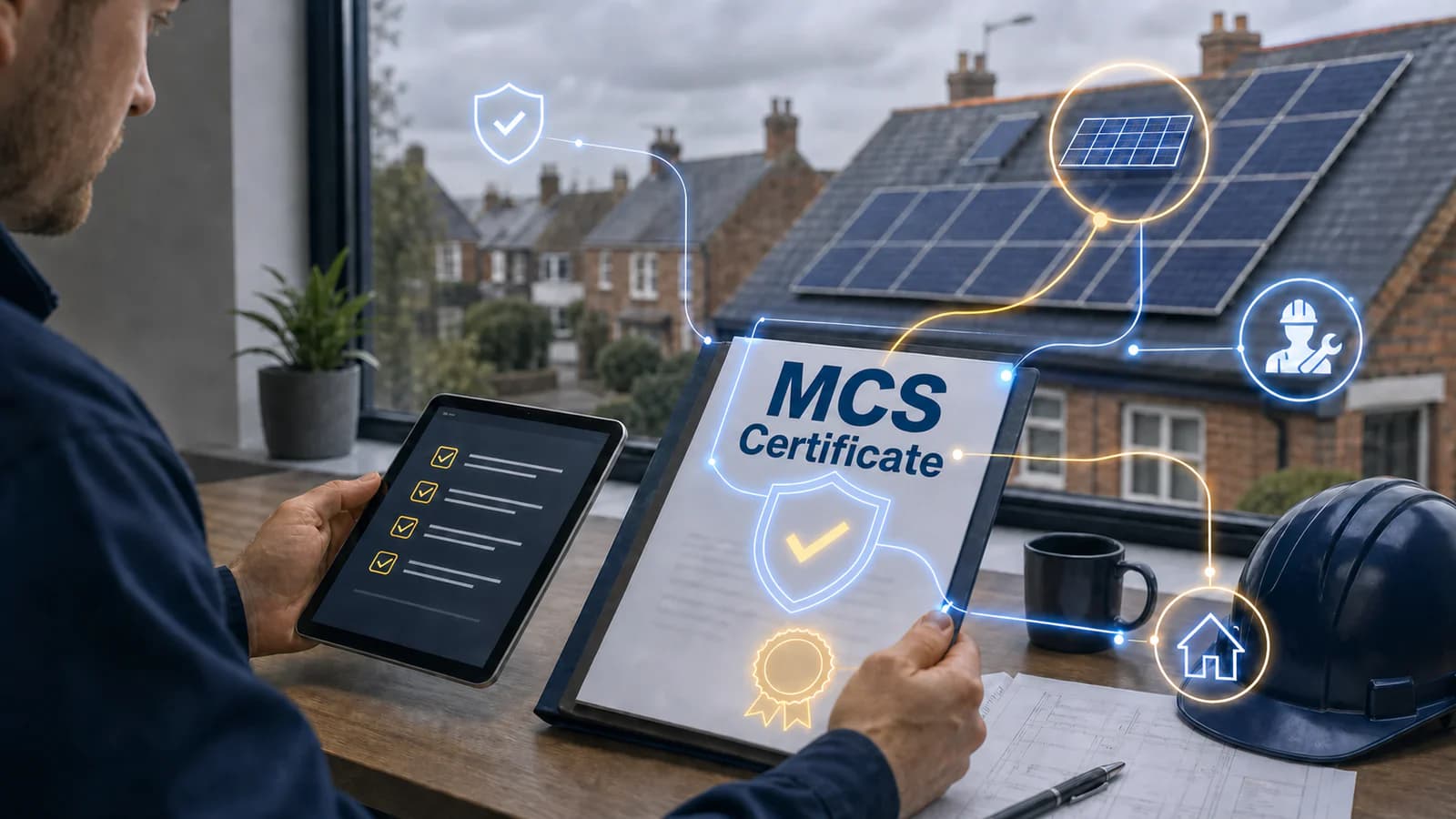
What Is MCS Certification?
MCS stands for the Microgeneration Certification Scheme, the UK's quality assurance framework for small-scale renewable technologies: solar PV, battery storage, solar thermal, heat pumps, and a handful of adjacent microgeneration technologies[1].
MCS certification covers several distinct things, and mixing them up is where a lot of confusion starts:
- Installer (business) certification confirms your company runs a compliant quality management system, that staff meet competency requirements, and that installations are assessed against the relevant standard.
- Product certification or approval applies separately to individual equipment, such as mounting systems certified under their own MCS product standard. You specify equipment that already carries the relevant approval; you do not certify products yourself.
- The installation standard sets out how a system must be designed, installed, commissioned, and handed over for a given technology. For solar PV this is MIS 3002, which governs the installation process, not a product-certification mark for panels, inverters, or batteries[3].
- The installation certificate is the per-job document your certified business (or the umbrella operator) issues once an installation is complete and compliant, generated project by project rather than once for the whole company.
Important MCS Changes: The 2026-2027 Transition
MCS is rolling out its redeveloped installer scheme throughout 2026 and into 2027; the current scheme runs until 31 March 2027, by which point all MCS-certified installers must have moved onto the redeveloped scheme[8]. New applicants may already be assessed under the redeveloped scheme, while existing certified businesses transition according to their certification body's own schedule, on a date the body sets rather than one you can choose[7]. The core pieces are:
- The Installer Operating Requirements and the Customer Commitment are now the two documents that define an installer's obligations, replacing some of the previous scheme documentation. The Customer Commitment specifically sets out how customers must be treated and must be given to them at first point of contact, before any contract is signed.
- A named Technical Supervisor is now required to sign off every installation, giving clearer individual accountability for technical quality. Technical Supervisors need an in-date qualification under the Installer Operating Requirements; those who previously operated under grandfather rights have until 1 April 2028 to obtain one.
- An MCS-approved financial protection product is now mandatory for every customer, arranged by the installer, providing at least six years of cover and a remediation route even if the original installer will not resolve an issue. Consumer Code membership (such as RECC) is no longer a general MCS requirement once a business has transitioned, though some installers retain it and specific funding schemes may still require it[9].
- Assessments are moving toward a more risk-based model focused on delivered quality, operational controls, and customer outcomes, rather than a fixed administrative cycle.
Because this transition is still active, treat any process detail you read, including in this guide, as a snapshot that should be checked against your certification body's current requirements before you apply.
Why MCS Certification Matters
MCS certification is not a paperwork exercise. It affects several things that directly influence whether you close and keep a deal.
- Smart Export Guarantee (SEG) eligibility. This is the main reason customers ask whether you need an MCS certificate for solar panels: for solar PV installations up to 50kW, an MCS certificate is the standard way to demonstrate that the installer and installation are suitably certified[10]. The system also needs an export meter capable of half-hourly measurement and its own export MPAN; an existing meter may already be suitable, depending on the SEG licensee's requirements. MCS is the standard route, not the only one, since Ofgem also accepts certain equivalent certification methods, and individual SEG licensees can add their own requirements on top.
- Grant and scheme access. MCS underpins several government-backed and council-led schemes, but not every renewables grant covers every technology. The Boiler Upgrade Scheme, for example, requires MCS certification but funds heat pumps and biomass boilers, not solar PV, so it is not a solar grant[11]. Where a solar-specific scheme (an ECO4-funded measure, a council group-buying scheme) applies locally, confirm its current rules before quoting a customer.
- Financial protection for the customer. Under the redeveloped scheme, installers must arrange an MCS-approved financial protection product for each customer, covering remediation for at least six years even if the original installer will not resolve an issue[9]. Consumer Code membership, such as RECC, is no longer a general MCS requirement once a business has transitioned, though some installers keep it and specific funding arrangements may impose their own conditions[12].
- Customer trust. MCS status is also an important trust signal for homeowners comparing solar installation companies.
MCS Certification Routes: Direct vs. Umbrella Working
There are two structurally different ways to carry out MCS-covered work, and they are not simply two paths to the same outcome.
| Direct MCS certification | MCS umbrella working | |
|---|---|---|
| Who holds the certification | Your company, directly with a certification body | The umbrella operator; your company is not independently certified |
| Who contracts with the customer | Usually your company | Typically the operator, or your company under the operator's procedures |
| Who registers the installation and issues the certificate | Your company | The umbrella operator, in the operator's name |
| Upfront cost | Higher (full assessment and audit) | Generally lower, but varies by operator |
| Ongoing cost | Renewal fee plus risk-based, ongoing surveillance (assessment frequency varies) | Joining or membership fee, plus per-project or margin-based charges set by the operator |
| Control over brand, products, and process | Full control, within MCS requirements | Set largely by the operator |
| Compliance responsibility | Sits with your business | Sits with the operator, who assumes responsibility at handover |
| Scalability and independence | Full long-term control, but a longer path to start | Faster start, but your ability to keep working MCS-covered jobs depends on the operator's certification staying valid |
| Best suited to | Installers planning long-term scale, multiple technologies, or their own brand on the certificate | New entrants, sole traders, and businesses testing solar demand before committing to independent certification |
What Is an MCS Umbrella Scheme?
An MCS umbrella scheme is an arrangement where an MCS-certified operator, who typically handles the design and commissioning of a system, subcontracts some or all of the physical installation. The operator holds a written agreement with each subcontractor, checks their competence and insurance, supervises the work, and takes full responsibility at handover. The completed job is registered on the MCS database under the operator's certification, which is what gives the customer access to SEG and other MCS-linked schemes[2]. Your own company does not become independently certified by joining; the real trade-off is faster, cheaper access to MCS-covered work in exchange for less control and no certification of your own.
Step-by-Step: How to Apply
The exact detail differs by certification body or umbrella operator, but the shape of the process is broadly consistent.
- Decide your route and scope. Direct certification for long-term ownership of your own status across technologies; umbrella working to start quickly as a sole trader, small team, or a business adding solar to existing electrical or roofing work.
- Select an approved certification body, or an umbrella operator. Direct route: an MCS-approved body such as NICEIC or NAPIT. Umbrella route: vet an operator's terms, product requirements, and fees.
- Confirm Technical Supervisor and competency requirements. Direct applicants need a named Technical Supervisor with an in-date qualification; umbrella subcontractors meet the operator's own requirements instead.
- Arrange insurance and financial protection. Public liability insurance is a hard prerequisite either way. Direct applicants also need to arrange an MCS-approved financial protection product for their customers; umbrella subcontractors typically work under the operator's existing arrangements instead.
- Prepare business operating procedures and project records. Direct applicants document their own quality management system against the Installer Operating Requirements; umbrella subcontractors work within the operator's existing system.
- Prepare for assessment. Direct applicants need a compliant installation ready for their certification body's site assessment. Umbrella subcontractors complete the operator's onboarding and competency checks instead; some operators review or supervise a subcontractor's first installation before approving ongoing work, though this is set by the operator rather than a fixed MCS rule.
- Complete the assessment. The certification body's office, technical, and site assessment (direct), or the operator's onboarding review (umbrella).
- Resolve any non-conformities flagged before certified or approved subcontractor status is confirmed.
- Start operating. Both routes carry ongoing obligations afterward: ongoing, risk-based surveillance and periodic site assessments for direct certification, continued compliance with the operator's terms for umbrella working.
How Much Does MCS Certification Cost?
Cost structures for the two routes are genuinely different, not just different price points on the same scale.
Direct certification fees vary by certification body, technology scope, and how many Technical Supervisors you need assessed, so a single "typical" figure is misleading.
NICEIC MCS Fees as a Worked Example
As one published example, for a single technology NICEIC's 2026/27 fees are:
| Fee | Amount (ex VAT) |
|---|---|
| First-year certification | £855 |
| Renewal (year two onward) | £640 |
| MCS licence fee (annual, in addition) | £55 |
| Training, insurance, and remediation | Not included, varies |
Additional assessments (extra technologies, extra Technical Supervisors) are charged on top, and other certification bodies publish their own fee schedules that may differ from this example.
What Umbrella Working Costs
Umbrella working does not have a single typical price. Each operator sets its own joining or onboarding fee, and its own ongoing charges, which may be a monthly or annual membership fee, a per-project administration or design fee, a margin or revenue share on the work, or some combination of these. Umbrella working can reduce your upfront cost significantly, but it is not automatically cheaper overall, especially at higher project volumes, where per-job fees and margin arrangements can add up to more than the ongoing cost of independent certification.
Confirm current fees directly with your certification body or umbrella operator, and ask what is included (assessment, first-job audit, surveillance, per-project charges, the separate MCS licence fee) rather than comparing a single headline number. The NICEIC figures above were checked in July 2026 and exclude VAT; other bodies and umbrella operators price differently.
How Long Does MCS Certification Take?
Direct certification does not come with a guaranteed timeframe. Industry guidance commonly estimates around 6 to 12 weeks for a well-prepared application[14], but certification bodies do not commit to this range, and it depends heavily on their current workload, how complete your quality management system documentation and competency evidence are, and how quickly you can present a genuinely compliant first installation for audit. Some applications take several months if corrective action is needed.
Umbrella onboarding is generally faster, since the operator's accreditation and quality management system already exist. Providers commonly describe onboarding in terms of a few weeks once your qualifications, insurance, and documentation are ready, though the exact timeline is set entirely by the operator you choose.
The variables that actually move these numbers are the certification body's or operator's current availability, how complete your paperwork is on first submission, whether your Technical Supervisor's qualifications are in date, and whether your first assessed installation passes without non-conformities.
What Does an MCS Installation Certificate Contain?
An MCS installation certificate is a per-installation document, not a company-wide badge. A standard certificate is expected to show:
- The certified business's (or umbrella operator's) name and MCS reference number
- The installation address
- The technology installed and the standard it was completed under, for example solar PV under MIS 3002
- The equipment make, model, and system size
- The commissioning date
- The certifying body or scheme issuing it
Exact fields can vary slightly by certification body, so treat this as the standard content rather than a fixed template. A new certificate is generated for each qualifying job, not once when a business first becomes certified. Homeowners typically receive a copy as part of handover documentation, and it is the document a SEG licensee or grant scheme will usually ask to see.
MCS Application Readiness Checklist
Certification is not the finish line: every subsequent project still has to be designed, documented, and commissioned to the same standard. A consistent feasibility study and system design process for every job, built with PV design software rather than assembled by hand each time, is what keeps that documentation audit-ready. SolarVis's Solar 3D Design and Solar Proposal Software are already used by 1,800+ solar installers to run exactly this kind of workflow.
Have the basics in place before you contact a certification body or umbrella operator, rather than assembling them mid-application:
- Public liability insurance (and professional indemnity, where relevant) confirmed and in date
- Installer and Technical Supervisor training mapped against the Installer Operating Requirements
- A decision on direct application versus umbrella working, and, if umbrella, at least two operators compared on cost and terms
- MCS-approved financial protection arrangements confirmed, plus any additional consumer-code or funding-scheme requirements applicable to your business
- Project record-keeping and quality management system documentation ready to show, not just described
- A specific installation identified that can genuinely stand up to a first assessment
- A plan for who reviews design and documentation on every job afterward, not only the one used for certification
Working through this list is what usually separates a fast assessment from a stalled one, but certification bodies and umbrella operators still make their own decisions.
For a broader view of how installer growth and lead generation connect to this kind of operational readiness, see how to generate solar leads.
How the MCS Standards Work Inside solarVis
Certification is what lets a job be registered. Every job after that still has to be designed, calculated, and documented against the standards sitting behind MCS: MIS 3002 for the installation itself, MGD 005 for shade, MCS 012 for the mounting products, and the MCS irradiance datasets for the generation figure the customer is shown. Four of those map onto the same UK project in solarVis, because the roof is modelled once and the shade factor, the product selection, the mounting check, and the generation estimate all come off that one model instead of being reassembled by hand on every job, then land in the proposal the customer actually reads.
- Shade evaluation to MGD 005. The procedure scores shading on an 84 segment sunpath chart and penalises near objects hardest: anything within 10m of the array centre gets a shade circle, which in the procedure's own worked example drops one obstruction from a shade factor of 0.89 to 0.60[4]. Chimneys, dormers, and neighbouring buildings are already modelled as real geometry, so the shading analysis and the MGD 005 diagram come off the same model that produced the layout, per array and per panel.
- MCS certified products at the point of selection. MCS certifies equipment separately from installers, so a certified product carries its own certificate number and declared performance data[1]. The solarVis material database holds what your business actually sells and surfaces certification status while the design is being made, not at handover, and the selection carries through to the bill of materials and the proposal unchanged.
- Structural and load checks for the mounting system. MCS 012 issue 3.0, mandatory since 10 May 2025, requires the wind load calculated for that site and that position on the roof to stay under the product's declared uplift resistance[6]. Roof pitch, array position relative to edges and corners, panel count, and solar racking layout all come out of the design, so the check runs against what will actually be installed. It does not replace a structural engineer's judgement where one is needed, it makes the inputs the same on every job.
- Production on the MCS irradiance datasets. The standard UK estimate is built from the MCS datasets plus orientation, pitch, shade factor, and installed capacity[5], which is why a generic global model gives two quotes for one property that do not agree. For UK projects, solarVis calculates on the MCS datasets using the geometry already in the design, so the figure holds up under assessment whoever prepared the quote.
- All of it lands in the proposal. At the end of the project the same data appears in the customer document: the products that were specified, the shade factor behind the yield, and the generation figure calculated on the MCS datasets. The customer sees the basis of the numbers rather than a bare total, and the business keeps a consistent record of what was designed if the job is assessed later.
MCS 012 is at issue 3.0, MGD 005 is guidance rather than a mandatory requirement in its own right, and MIS 3002 has been revised more than once in recent years. Before you rely on any figure in this section, confirm the current issue of the document on the MCS standards library.
Frequently asked questions
References
- MCS (Microgeneration Certification Scheme), official site
- MCS, Umbrella Schemes
- MCS, MIS 3002: The Solar PV Installation Standard
- MCS, MGD 005: Solar PV Shade Evaluation Procedure
- MCS, Irradiance Datasets
- MCS, MCS 012 Issue 3.0: The Solar Mounting Standard (Product)
- MCS, A Guide to the New Business Roles Under MCS' Redeveloped Installer Scheme
- MCS, Moving Over to the Redeveloped Installer Scheme
- MCS, MCS Approved Financial Protection Products
- Ofgem, Smart Export Guarantee (SEG)
- Ofgem, Boiler Upgrade Scheme (BUS): Installers
- RECC, Renewable Energy Consumer Code
- NICEIC, MCS Contractor Scheme Fees
- Brighter Compliance, MCS Certification UK Guide

